Scottsdale's growth from an agricultural outpost to a dense urban corridor hasn't erased its most persistent challenge: the ground itself. The city sits on a mix of ancient alluvial fans, windblown deposits, and pockets of caliche that vary within a single parcel. A soil mechanics study here isn't just a permit step. It's the only reliable way to catch the difference between a stiff layer that holds a shallow foundation and a collapsible silt that settles unevenly under irrigation. Our team has tested sites from the McDowell Sonoran Preserve edge to the infill projects near Old Town, applying laboratory characterization and field logging that align with IBC Chapter 18 and the site-class criteria in ASCE 7. When homeowners ask why their neighbor's slab cracked after two monsoon seasons, the answer almost always traces back to a skipped or incomplete grain-size analysis that missed the silty fraction responsible for moisture sensitivity.
Scottsdale soils can lose over half their bearing capacity when wet. A study that tests both as-compacted and saturated conditions gives the structural engineer the full picture.
How we work
Local ground factors
A developer planned a two-story medical office at the corner of Scottsdale Road and Shea Boulevard, assuming the site was a uniform gravel terrace. The initial geotechnical report relied on two shallow borings that terminated in caliche. During excavation, the contractor uncovered a buried wash channel filled with loose, uncompacted silt running diagonally under half the building footprint. The soil mechanics study had to be expanded immediately — additional borings, laboratory consolidation tests, and a revised bearing capacity analysis. The fix wasn't cheap: over-excavation down to competent material, engineered fill compacted in lifts, and a delay that pushed the shell completion past the tenant's lease deadline. That sequence plays out more often than it should in Scottsdale, where desert pavement at the surface can hide irregularities deposited during the Pleistocene flooding of the Salt River basin. A thorough study with adequate boring depth and targeted lab testing on each stratum is the only insurance against that kind of discovery mid-construction.
Reference standards
ASTM D2487: Standard Practice for Classification of Soils for Engineering Purposes (Unified Soil Classification System), ASTM D1586: Standard Test Method for Standard Penetration Test (SPT) and Split-Barrel Sampling of Soils, IBC Chapter 18: Soils and Foundations, ASCE 7-22: Minimum Design Loads and Associated Criteria for Buildings and Other Structures
Complementary services
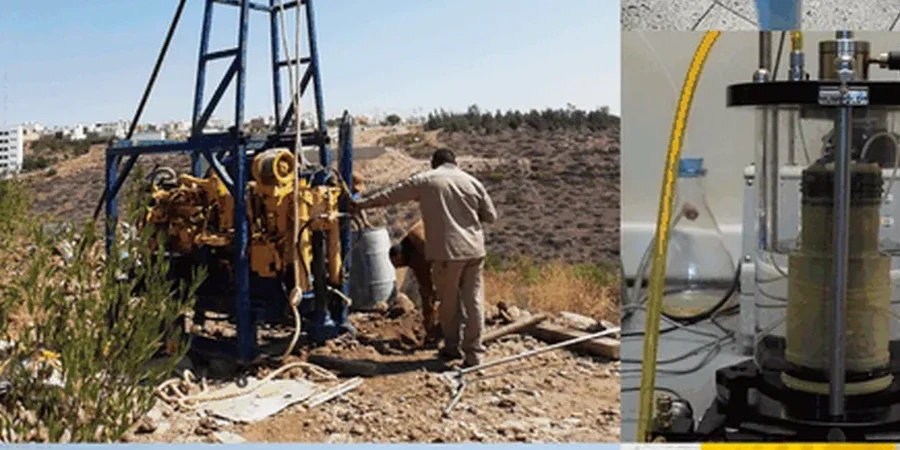
Field Exploration and Sampling
Buckets auger borings, SPT sampling, and test pits to map stratigraphy and collect undisturbed samples. We log moisture, density, and caliche continuity per ASTM D2488 before samples ever reach the lab.
Laboratory Testing Suite
Grain-size distribution, Atterberg limits, direct shear, consolidation, and collapse potential tests. All testing runs under our AASHTO-accredited quality system so the numbers stand up to plan-check review.
Foundation Recommendations Report
A signed, sealed report with allowable bearing pressures, anticipated settlement, slab-on-grade parameters, and sulfate exposure classification. We include pavement design inputs when the project has parking or access road scope.
Typical parameters
Common questions
What does a soil mechanics study in Scottsdale typically cost?
For a standard single-family lot or small commercial parcel, the study ranges between US$3,620 and US$4,920. The final number depends on boring depth, how many samples need lab testing, and whether specialized tests like collapse potential or direct shear are required by the structural engineer.
How deep do the borings need to go for a two-story building?
Per IBC Table 1804.2, borings should extend through any questionable bearing strata and at least 20 feet below grade for a two-story structure, or deeper if the stress influence extends further. In Scottsdale, we often deepen borings to get below the caliche horizon and confirm no loose wash deposits exist underneath.
What's the difference between a soil mechanics study and a standard soils report?
A soil mechanics study goes further than a basic report. It includes laboratory strength testing on undisturbed samples and engineering analysis of settlement, bearing capacity, and soil-structure interaction. A standard report may only offer visual classification and presumptive values, which can be risky on Scottsdale's variable alluvial soils.
How long does the study take from the first site visit to the final report?
For a typical commercial site, expect two to three weeks. Fieldwork takes one to two days. Lab testing runs five to seven business days, depending on the suite. The report write-up, analysis, and senior review add another week. Rush turnaround is available when the contractor is already mobilizing.