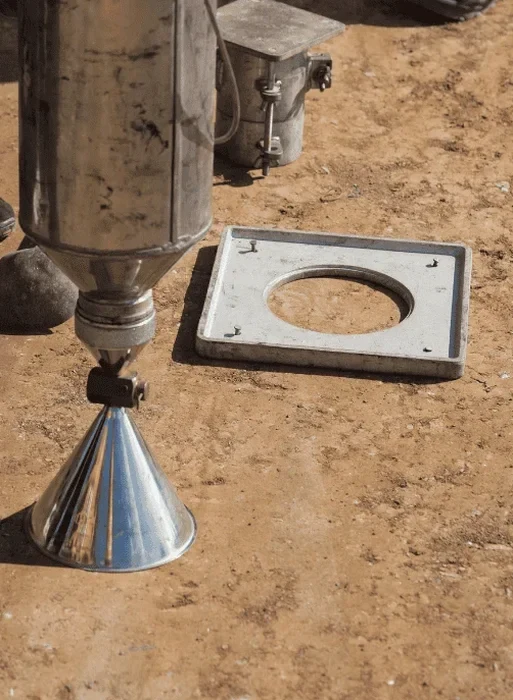
In Scottsdale, we see a recurring issue on commercial pads near the McDowell Mountains where crews hit caliche layers that give a false sense of solid compaction, yet underneath the fill is barely at 85% of modified Proctor. That scenario leads to post-construction settlement nobody wants to explain to a client six months after the certificate of occupancy. We run the sand cone density test because it gives a direct weight-over-volume measurement that nuclear gauges can misread in aggregate-rich desert borrow. When the project requires validation for the City of Scottsdale’s earthwork acceptance, we pair the field check with laboratory moisture-density curves to confirm the spec is met before the next lift goes down.
Compaction on Scottsdale’s desert soils is a moisture game — miss the optimum by two percent and the density drops faster than most specs allow.
How we work
Local ground factors
Scottsdale’s build-out from the 1980s onward pushed development onto old alluvial fans where the upper three feet often look competent but hide loose lenses deposited by flash flood overbank flows. Those lenses collapse under saturation if a landscape irrigation line leaks, and the resulting differential movement cracks slabs and hardscape within a single monsoon season. Missing a density check on a utility trench backfill in the Indian Bend Wash area creates a linear weak zone that attracts water and accelerates pavement fatigue. The sand cone method catches density shortfalls that density gauges can overestimate when the soil contains mica or iron-rich particles common in the decomposed granite found around Pinnacle Peak.
Reference standards
ASTM D1556 – Standard Test Method for Density and Unit Weight of Soil in Place by Sand-Cone Method, ASTM D1557 – Standard Test Methods for Laboratory Compaction Characteristics of Soil Using Modified Effort, ASTM D2216 – Standard Test Methods for Laboratory Determination of Water (Moisture) Content of Soil and Rock by Mass, IBC Chapter 18 – Soils and Foundations, ASCE 7 – Minimum Design Loads and Associated Criteria for Buildings and Other Structures
Complementary services
In-Place Density by Sand Cone
Direct measurement of compacted fill density using the sand cone method per ASTM D1556. We offer relative compaction as a percentage of the laboratory maximum dry density from the project’s Proctor curve, with immediate field calculations and a formal report within 24 hours.
Utility Trench Backfill Verification
Targeted density testing on utility trench backfill lifts for water, sewer, and gas line installations. We work alongside City of Scottsdale inspectors to meet the compaction thresholds required before pavement restoration, reducing the risk of trench settlement within the warranty period.
Problem-Soil Moisture-Density Correlation
When native desert soil contains expansive clay or caliche fragments, the standard Proctor may not tell the full story. We run side-by-side sand cone and lab compaction checks to identify moisture sensitivity and recommend adjustment to the compaction spec before the fill operation falls behind schedule.
Typical parameters
Common questions
How much does a sand cone density test cost in Scottsdale?
A single field density test using the sand cone method typically runs between US$90 and US$150, depending on the number of tests scheduled per mobilization and the travel distance to the site. Volume pricing kicks in for larger earthwork projects where we perform multiple tests in a single day.
When is the sand cone method preferred over a nuclear gauge in Arizona?
The sand cone method is specified when the soil contains aggregate larger than about 1.5 inches, when magnetic or mineralogical interference affects a nuclear gauge reading, or when the project requires a direct mass-volume measurement for dispute resolution. In Scottsdale’s decomposed granite and caliche-bearing fills, the sand cone often gives a more defensible density value than a gauge.
How deep does the sand cone test hole need to be?
The test hole should extend through the full thickness of the compacted lift, which is commonly 6 to 12 inches for structural fill and road base in the Scottsdale area. For base course under rigid pavement, we match the hole depth to the spec lift and ensure the density plate sits flat on a level surface free of loose material.
What moisture content method do you use alongside the sand cone?
We determine moisture content by oven-drying the excavated material per ASTM D2216, either in a field oven for quick turnaround or in our laboratory when the highest accuracy is required. Knowing the exact moisture content is critical in Scottsdale because the desert soils lose water rapidly after placement, and a half-percent difference can shift the apparent relative compaction by several points. More info.