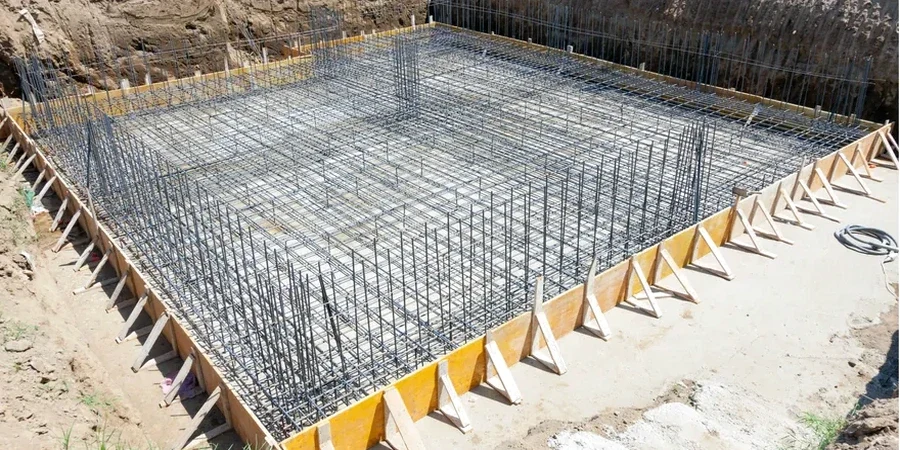
In Scottsdale, a mat foundation often makes more sense than isolated footings once you factor in the soil variability across the valley. You can hit dense caliche at three feet on one corner of the lot and find sandy wash deposits at the other. That’s not unusual here—the city sits on a complex alluvial fan system where subsurface conditions shift over short distances. A rigid raft slab bridges those inconsistencies, reducing differential settlement and keeping the structure level as the soil responds to monsoon moisture cycles. When the design team reviews the geotechnical report, they look at the allowable bearing pressure and the anticipated total and differential settlement. We rely on CPT testing to map the vertical profile continuously and identify thin problematic lenses that standard borings might miss. This data feeds directly into the structural model so the mat thickness and reinforcement are calibrated to actual ground conditions, not just conservative assumptions.
A mat foundation in Scottsdale is not a generic slab—it is a soil-structure interaction problem solved with local stratigraphy and field-measured stiffness values.
How we work
- Variable slab thickness from 18 to 36 inches depending on column loads and soil stiffness
- Perimeter deepened edge beams for expansive clay heave protection
- Continuous reinforcement top and bottom with additional shear reinforcement at critical zones
- Subgrade modulus validated through local field testing, not generic published ranges
- Sulfate-resistant concrete specification based on soil chemistry from site investigation
Local ground factors
IBC Chapter 18 and ASCE 7-22 require a site-specific investigation for mat foundations, and in Scottsdale that requirement carries extra weight. The city’s geotechnical hazards include hydro-collapsible soils in the northern reaches near Carefree Highway, where silty sands can lose structure when wetted by landscape irrigation or monsoon infiltration. There are also pockets of expansive clay in older alluvial terraces that swell when moisture content rises. A mat foundation designed without accounting for these behaviors can knowledge edge lift or center heave that cracks partition walls and binds doors. The investigation must sample the upper 15 to 20 feet—enough to capture the active zone influenced by moisture fluctuation. Laboratory testing for expansion index and collapse potential per ASTM D5333 and D4546 gives the numbers needed to decide whether the mat needs deepened perimeter beams or a moisture-controlled subgrade. Ignoring these desert-specific mechanisms during the design phase leads to foundation repairs that cost far more than the original engineering fee.
Process video
Reference standards
IBC 2024 (Chapter 18: Soils and Foundations), ASCE 7-22 (Minimum Design Loads), ACI 318-19 (Building Code for Structural Concrete), ASTM D2487 (Unified Soil Classification), ASTM D4546 (One-Dimensional Swell/Collapse), ASTM D5333 (Collapse Potential of Soils)
Complementary services
Geotechnical investigation and soil-structure interaction parameters
Subsurface exploration using SPT borings and CPT soundings to characterize Scottsdale basin-fill stratigraphy. Laboratory testing program includes expansion index, collapse potential, sulfate content, and consolidation parameters. We deliver the modulus of subgrade reaction, allowable bearing pressure, and settlement predictions formatted for direct input into the structural engineer's mat foundation model.
Structural design of reinforced concrete mat foundation
Analysis of the raft slab as a soil-supported plate using finite element methods. Design covers flexural reinforcement, punching shear at column connections, perimeter edge beams for heave control, and construction joint detailing. Drawings and calculations are sealed by a licensed structural engineer and comply with IBC, ACI 318, and City of Scottsdale plan review requirements.
Typical parameters
Common questions
When does a mat foundation make more sense than isolated footings in Scottsdale?
A mat foundation becomes the better option when soil bearing capacity drops below roughly 2,500 psf, when the footing area exceeds half the building footprint, or when differential settlement between columns is a concern due to variable soil profiles. In Scottsdale, we see this frequently on sites with interbedded sand, clay, and caliche layers where isolated footings would require extensive ground improvement to perform reliably.
What does a mat foundation design cost for a Scottsdale project?
Design fees for a mat foundation in Scottsdale typically range from US$950 for a straightforward residential slab on competent soil to US$4,490 for a commercial building requiring a full soil-structure interaction model, deepened edge beams, and coordination with the geotechnical report. The final cost depends on the footprint size, the complexity of the column layout, and the number of soil borings or CPT soundings available for analysis.
How does caliche affect the design of a mat foundation?
Caliche—cemented calcium carbonate layers common in Scottsdale—can offer excellent bearing capacity but also creates a rigid interface that complicates excavation and can trap water above it. The design must check whether the caliche layer is continuous under the entire mat or occurs in isolated lenses. If it is discontinuous, differential stiffness across the slab becomes the controlling factor, and the reinforcement layout must bridge softer zones between the hard caliche nodules.