Too many foundation cracks in Scottsdale trace back to one overlooked detail: the plasticity of the soil. A standard bearing capacity check won't tell you how the ground behaves when it finally gets wet. The Atterberg limits test fills that gap. It measures the liquid limit, plastic limit, and plasticity index—three numbers that define whether your site’s clay will shrink, swell, or stay put. Our lab runs the procedure under ASTM D4318, delivering results that structural engineers and geotechnical consultants rely on to design slab-on-grade foundations, retaining walls, and pavement sections across Maricopa County. For deeper stratigraphic context, we often pair Atterberg limits with test pits to log soil horizons and with grain size analysis to complete the USCS classification required by Scottsdale building officials.
The plasticity index from an Atterberg limits test is often the single most predictive number for foundation movement in Scottsdale’s expansive basin-fill soils.
How we work
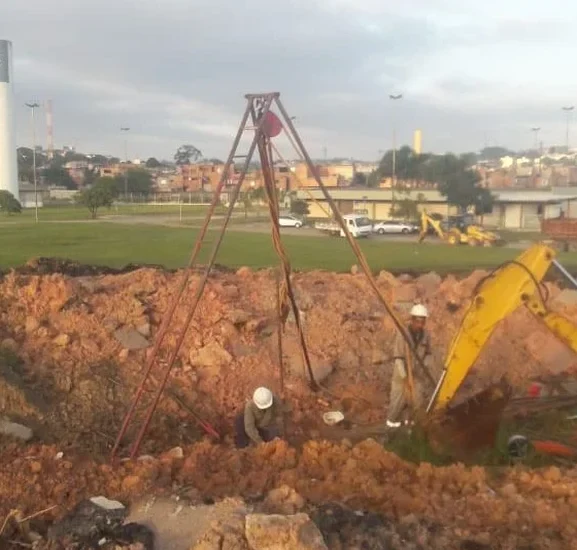
Local ground factors
Scottsdale’s monsoon season, which runs from June through September, transforms inert clay into a swelling hazard. A soil that sat dry at 8 percent moisture in May can jump to 18 percent after a single afternoon storm, crossing the plastic limit and entering a workable state that deceives grading crews. If the Atterberg limits weren’t measured beforehand, no one knows the real shrinkage potential. That’s how post-tensioned slabs end up with edge lift and interior cracks three years after construction. The IBC requires classification per ASTM D2487, and Scottsdale plan reviewers check for it. Skipping this test on a site with even 15 percent fines is a gamble. We’ve seen liquid limits above 60 in soils near the Indian Bend Wash, where clay layers interbed with clean sand—a profile that looks stable in a boring log but swells laterally when wetted. Pairing Atterberg limits with a liquefaction assessment becomes relevant where the fines content and plasticity affect cyclic resistance ratios in deeper saturated layers.
Reference standards
ASTM D4318-17e1: Standard Test Methods for Liquid Limit, Plastic Limit, and Plasticity Index of Soils, ASTM D2487: Standard Practice for Classification of Soils for Engineering Purposes (Unified Soil Classification System), IBC Section 1803: Geotechnical Investigations
Complementary services
Standard Atterberg Limits (LL, PL, PI)
Multi-point liquid limit determination with Casagrande cup, plus plastic limit by hand-rolling. Includes flow curve, plasticity chart classification per USCS, and a signed report suitable for Scottsdale building permit submittals. Same-day sample logging available.
Full Index Package with Grain Size
Atterberg limits combined with sieve and hydrometer analysis to produce a complete ASTM D2487 classification, including group symbol and name. Recommended for projects requiring shrink-swell potential assessment or correlation with local geohazard maps.
Typical parameters
Common questions
What do Atterberg limits actually tell a structural engineer?
The liquid limit and plastic limit define the moisture range where a fine-grained soil behaves plastically. The difference, the plasticity index, correlates strongly with shrink-swell potential. A PI above 25 signals high expansion risk in Scottsdale’s basin clays, which directly influences foundation type selection and slab reinforcement.
How much does Atterberg limits testing cost in Scottsdale?
A standard Atterberg limits test (LL, PL, PI) runs between US$70 and US$100 per sample when bundled with other index tests. The exact cost depends on whether you need the full multi-point procedure or if the sample requires special preparation to remove gypsum or salts, which are common in desert soils.
Can you run Atterberg limits on site, or does it need a lab?
The Casagrande cup method requires a controlled lab environment: level workbench, calibrated cup, and constant-rate drying. Field approximations exist, but Scottsdale plan reviewers and geotechnical reports almost always require ASTM D4318 lab results. We process samples at our facility and can log them within 24 hours of delivery.
Is the one-point liquid limit method acceptable for my project?
The one-point method, described in ASTM D4318 Annex A, is faster but less accurate for soils near the A-line on the plasticity chart. For Scottsdale sites with borderline clay/silt behavior, we run the full multi-point test. The IBC does not prohibit the one-point method, but many geotechnical reviewers in Maricopa County request the full flow curve for critical structures.