The ground beneath north Scottsdale tells a different story than the alluvial fans near Tempe. In the McDowell Mountain foothills, granite bedrock can rise within 15 feet of the surface, while parcels along Indian Bend Wash sit atop interbedded sands and clays deposited by episodic flooding. That contrast matters when you are siting a foundation, planning a deep excavation, or verifying compacted fill. Seismic tomography, both refraction and reflection, lets us map those velocity boundaries without a single borehole guess. We run the geophone spread, trigger the source, and watch how P-waves and S-waves refract across the interface between weathered rock and competent granite. The result is a continuous subsurface profile showing layer geometry, rippability, and potential voids. For projects near the McDowell Sonoran Preserve, where access restrictions limit drilling, this approach saves time and avoids permit delays. When borehole control is available, we integrate the velocity model with S-wave MASW data to constrain shear modulus at depth, giving the structural engineer a complete dynamic soil model.
A 2D velocity cross-section from seismic tomography reveals what a grid of boreholes can miss: the continuous geometry of buried channels, weathered zones, and fault splays.
How we work
Local ground factors
The most expensive mistake we see in Scottsdale is a contractor drilling piers to refusal on what they think is bedrock, only to discover it is a float block or a boulder field embedded in softer matrix. Seismic refraction tomography would have shown the continuous velocity profile and flagged the irregular bedrock surface. Another common failure involves excavation dewatering plans that assume uniform soil permeability; a paleochannel with high velocity contrast may indicate coarse gravel that drains much faster than the surrounding material, flooding the cut and delaying work for weeks. Without a velocity model, you are designing blind. The IBC requires site-specific ground motion analysis for structures in Seismic Design Category D and above, and ASCE 7-22 Chapter 21 ties site classification directly to shear-wave velocity measured in the upper 30 meters. Seismic tomography provides that Vs30 profile without relying solely on correlations from SPT blow counts, which can misclassify cemented soils as rock. If you skip the geophysical survey, you accept a higher uncertainty factor in your seismic design, and that translates to higher steel tonnage or foundation over-sizing, both of which hit your budget hard.
Reference standards
ASTM D5777-18: Standard Guide for Using the Seismic Refraction Method, ASTM D7128-18: Standard Guide for Using the Seismic Reflection Method, ASCE/SEI 7-22 Chapter 21: Site-Specific Ground Motion Procedures, IBC 2021 Section 1613: Earthquake Loads and Site Classification
Complementary services
Seismic Refraction Tomography
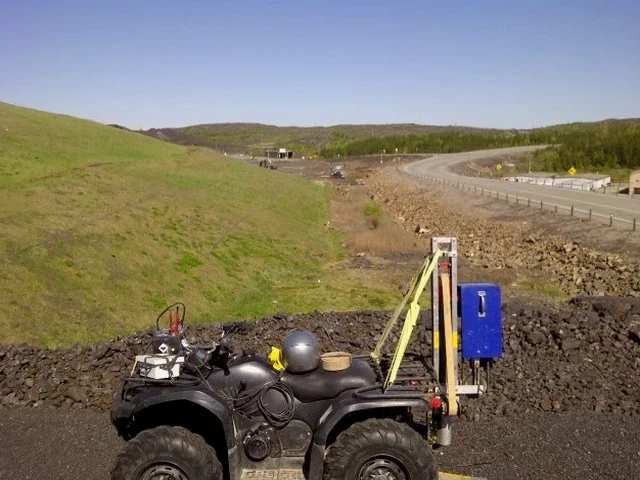
Ideal for mapping top-of-bedrock, rippability, and lateral velocity variations in the upper 20 meters. We use multiple shot points and ray-tracing inversion to produce a continuous 2D P-wave velocity section. Common applications include foundation design, cut-slope stability, and utility trench planning in desert hardpan and caliche.
Seismic Reflection Profiling
Deployed for deeper targets, basin structure, and fault imaging. We configure the spread with longer offsets and higher fold, processing with CMP sorting, NMO correction, and migration. This method resolves stratigraphic boundaries below 30 meters where refraction loses resolution, particularly useful for groundwater basin characterization and seismic hazard studies.
Typical parameters
Common questions
How much does a seismic tomography survey cost in Scottsdale?
For a typical site with 2 to 4 refraction lines totaling 300 to 500 linear meters, the cost ranges from US$2,910 to US$4,670. The final figure depends on line length, number of geophone channels, source type, and whether reflection acquisition and advanced processing are required. We offer a fixed-price proposal after reviewing your site plan and project objectives.
What is the difference between seismic refraction and reflection for site investigation?
Refraction measures the critical refraction of seismic waves along velocity boundaries, mapping layers where velocity increases with depth. It works best in the upper 15 to 30 meters and is the standard for bedrock mapping and rippability. Reflection records the energy reflected from acoustic impedance contrasts, similar to sonar, and can image deeper structures and velocity inversions. We often combine both: refraction for the near-surface velocity model to correct reflection statics, reflection for deeper fault and stratigraphic targets.
How long does the survey take and will it disrupt site work?
Field acquisition for a standard refraction line of 200 to 300 meters takes one day with a two-person crew. Processing and interpretation require an additional three to five business days. The survey is non-invasive; the geophones are planted at the surface and the energy source generates a brief, localized impact. No drilling, no heavy equipment, and minimal disruption to concurrent site activities.