At 1,257 feet above sea level, Scottsdale sits on a mosaic of Quaternary alluvial fans and pediment surfaces that define every deep excavation project here. We routinely encounter the Paradise Valley cemented sands and the notorious caliche layers just 8 to 15 feet below grade. These aren't soft soils you can excavate with a conventional bucket; they demand a careful pre-construction characterization to avoid costly delays. Our lab team approaches each project with a data-first mindset, running direct shear on undisturbed samples and correlating field SPT blow counts from our spt-drilling rigs to define the cementation profile before the first cut.
In Scottsdale, the difference between a successful deep cut and a collapse often lies in how well you mapped the caliche lenses before setting the first anchor.
How we work
Local ground factors
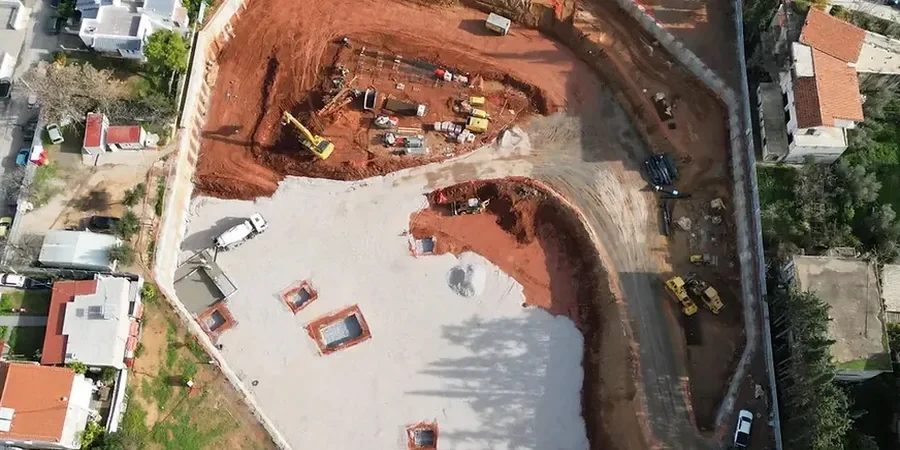
What we see repeatedly in Scottsdale is contractors assuming a uniform soil profile and then hitting an unexpected caliche ceiling at 12 feet. The excavator stops, the schedule slips, and the shoring design has to be revalidated mid-project. The real risk isn't just a cave-in; it's the brittle failure mode of overhanging cemented blocks that spall without warning. We recommend always pairing a preliminary excavation-monitoring plan with the design, particularly when working within 15 feet of existing slab-on-grade homes in McCormick Ranch or Paradise Valley. A single inclinometer reading that shows unexpected lateral movement is worth more than any theoretical safety factor.
Reference standards
IBC 2021 (with Scottsdale amendments), ASCE 7-22 Minimum Design Loads, ASTM D1586 Standard Test Method for SPT, ASTM D2487 Classification of Soils for Engineering Purposes, ASTM D2166 Unconfined Compressive Strength of Cohesive Soil, ASTM D3689 Standard Test Methods for Deep Foundations Under Static Axial Tensile Load
Complementary services
Shoring system analysis and detailing
We generate lateral earth pressure diagrams for soldier pile, secant pile, and soil nail configurations, adjusting for the high cohesion intercept of local caliche. Each calculation package includes global stability checks using Spencer's method.
Bracing and tieback design
We size internal braces, walers, and ground anchors based on the actual cementation profile. Our anchor bond lengths are verified against field pullout data, not just textbook bond values for generic sand.
Construction-phase pore pressure monitoring
Although Scottsdale excavations are usually dry, monsoon season can introduce perched water in colluvial channels. We install vibrating wire piezometers and define threshold values that trigger additional dewatering if needed.
Typical parameters
Common questions
What is the typical cost range for geotechnical design of a deep excavation in Scottsdale?
For a standard commercial excavation up to 30 feet, design and construction-phase support typically fall between US$1,870 and US$7,450, depending on the number of shoring levels, the complexity of the caliche mapping, and whether tieback load testing is included. Projects exceeding 40 feet or those adjacent to sensitive structures will be on the higher end due to the additional instrumentation and peer review requirements.
How does caliche affect the excavation design compared to normal sand?
Caliche acts as a naturally cemented, brittle material with significant cohesion—often exceeding 2,000 psf. We model it as an equivalent cohesive-frictional unit, but we also account for tension cracks that can propagate vertically behind the wall face. This means we cannot rely solely on apparent cohesion; we reduce it by a factor of 0.5 per local practice and add a minimum surcharge to simulate crack water pressure during monsoon months.
Do Scottsdale excavations typically require dewatering?
Most excavations above 30 feet in central and north Scottsdale are dry because the regional water table sits well below 100 feet. However, we always run a CPT with pore pressure dissipation tests to rule out perched groundwater in old wash deposits. If we detect perched water, we design a simple sump-and-pump perimeter system rather than deep wells, which is usually sufficient for the low transmissivity of the desert fines.