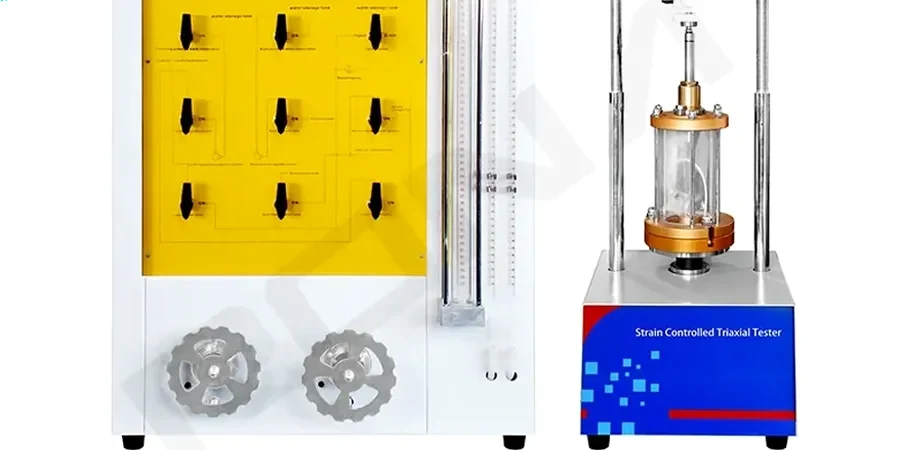
Scottsdale geology doesn't read textbooks. You go from coarse granitic alluvium near the McDowell Mountains to fine, cemented silts in the lower basins, and the summer monsoon can swing moisture content by 6 percent in 48 hours. That volatility punishes anyone who assumes a generic friction angle off a boring log. The triaxial test lets us isolate the stress path that actually governs the site: drained or undrained, compacted or undisturbed, saturated or at in-situ moisture. For projects pushing deep into decomposed granite or cutting into paleo-lake deposits north of the Central Arizona Project canal, we typically run consolidated-undrained triaxial with pore pressure measurement, because effective stress parameters are what the structural engineer needs to size footings and retaining walls without overconserving. The lab setup is calibrated to ASTM D4767 and D2850, and we process your Shelby tubes or remolded Proctor specimens with the same care whether it's a custom home in Silverleaf or a tilt-up warehouse in the Scottsdale Airpark.
Scottsdale hardpan gives peak friction angles above 38 degrees, but those numbers drop fast if the cementation dissolves after first wetting.
How we work
Local ground factors
Scottsdale sits on a patchwork of Quaternary alluvium, decomposed granite, and lenses of clayey paleosol that can hold perched water from irrigation overspray, even when the regional water table is 200 feet down. The 2015 flooding along the Indian Bend Wash showed how fast dry washes can saturate, and a soil that tested at 3,000 psf undrained shear strength in summer can lose 40 percent of that in September. If the triaxial program doesn't match the critical drainage condition, the foundation ends up designed for a scenario that exists maybe two months a year. For projects within Scottsdale's hillside overlay districts, where cut slopes expose weathered granite with relict jointing, we recommend multistage triaxial tests to capture the cohesion loss as strain accumulates. Maricopa County's geotechnical review now flags reports that rely solely on SPT correlations for shear strength when the site has more than 5 feet of expansive or collapsible material.
Reference standards
ASTM D4767 - Consolidated Undrained Triaxial Compression Test, ASTM D2850 - Unconsolidated Undrained Triaxial Compression Test, ASTM D7181 - Consolidated Drained Triaxial Compression Test, IBC Chapter 18 (referenced through ASCE 7 for seismic site class)
Complementary services
CU Triaxial with Pore Pressure
Consolidated-undrained testing for effective stress parameters, standard for foundation design in saturated or partially saturated Scottsdale soils.
CD Triaxial (Drained)
Slow-shear drained tests for long-term stability analysis of slopes and retaining structures where pore pressure dissipates over time.
UU Triaxial (Quick Undrained)
Unconsolidated-undrained testing for short-term bearing capacity in fine-grained soils, run at in-situ moisture without saturation.
Typical parameters
Common questions
What's the cost range for a triaxial test series in Scottsdale?
A full triaxial series in our lab typically runs from US$1,620 to US$2,940, depending on whether you need CU, CD, or multistage loading. The price includes specimen trimming, saturation verification, shearing at three confining pressures, and the Mohr-Coulomb report with stress path plots.
How long does a triaxial test take from sample to report?
A standard CU triaxial series on three specimens takes five to seven working days from sample receipt. CD tests run longer because the shear rate is an order of magnitude slower; expect eight to ten working days. We send preliminary friction angle and cohesion data as soon as the envelope is plotted, with the formal stamped report following within 24 hours.
Can you test desert hardpan or cemented soils in the triaxial cell?
Yes, and this is where specimen preparation matters most. Cemented hardpan from Scottsdale sites often requires careful end-trimming with a diamond saw to preserve the natural fabric. We run the test at confining pressures matched to the field overburden and note any post-peak softening in the report, because that behavior directly affects how the geotechnical engineer models long-term bearing capacity under repeated wetting cycles.