Scottsdale’s expansion from a small farming community into a 184-square-mile city has pushed development onto increasingly complex desert substrates. The transition from the alluvial fans of the McDowell Mountains to the finer sediments of the Salt River basin creates abrupt lateral changes in dynamic soil behavior, something a generic code-based site class often misses. A seismic microzonation study maps these variations block by block, quantifying how the ground will actually shake at a specific parcel. For projects near the Scottsdale Airport or along the Loop 101 corridor, understanding basin-edge amplification and the depth to the 2,500 m/s shear wave velocity horizon is not academic—it directly controls the seismic design category and the structural system cost. Our approach combines deep borehole data, MASW shear wave velocity profiling, and seismic refraction to build a three-dimensional ground model that feeds directly into response spectra per ASCE 7-22 Chapter 21.
A Scottsdale basin-edge site can see ground motion 40% higher than a rock site three blocks away—microzonation quantifies that difference before the foundation is designed.
How we work
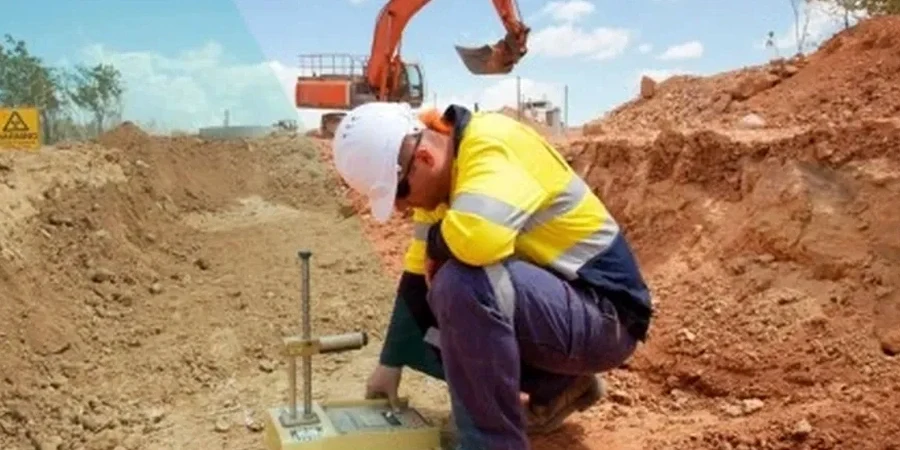
Local ground factors
A triaxial geophone array deployed in a 100-foot borehole along Scottsdale Road is our primary tool for measuring the small-strain shear wave velocity profile directly. The downhole method eliminates the inversion ambiguity of surface-wave techniques in layered desert soils, where a stiff caliche crust over softer sands can fool a simple dispersion curve. We lower a borehole source clamped against the PVC casing at five-foot intervals, triggering shear waves that the geophones record at 2,000 samples per second. The real hazard in Scottsdale is not distant fault rupture but localized amplification in the Salt River floodplain deposits, where impedance contrasts between cemented and loose horizons can trap seismic energy. A site classified as D by default code tables might behave as an E site under resonant conditions—a distinction that only a microzonation level study, with measured velocities and site-specific response analysis, can resolve before the structural engineer locks in the lateral force-resisting system.
Reference standards
ASCE 7-22 Chapter 21: Site-Specific Ground Motion Procedures, IBC 2021 Section 1613: Earthquake Loads with Scottsdale amendments, ASTM D7400: Standard Test Methods for Downhole Seismic Testing
Complementary services
Site-Specific Response Spectra Development
We generate uniform hazard spectra and site-specific design spectra using measured Vs profiles and time-history analysis for parcels where the default Site Class D assumption is overly conservative or demonstrably unsafe.
Liquefaction Hazard Mapping
Targeted SPT and CPT soundings across the Indian Bend Wash corridor feed a probabilistic liquefaction potential index map, identifying zones of zero, marginal, and high risk for shallow foundation design.
Typical parameters
Common questions
What triggers a microzonation requirement in Scottsdale?
Per the current IBC adopted by Scottsdale, a site-specific ground motion analysis is required when the site is classified as Site Class F (liquefiable soils, peats, very high plasticity clays) or when the design team opts to reduce seismic forces by proving a stiffer site class than the default Site Class D. We typically recommend it for any Risk Category III or IV structure exceeding three stories.
How long does a Scottsdale microzonation study take from field work to final spectra?
A typical study for a five-acre parcel takes three to four weeks. This includes two days of downhole seismic and MASW acquisition, one week for data processing and the one-dimensional site response runs, and ten business days for the interpretive report with the final mapped spectral accelerations.
What is the typical cost range for seismic microzonation in Scottsdale?
The fee for a parcel-scale microzonation in Scottsdale ranges from US$3,740 for a single-station MASW with simplified site classification to US$19,060 for a multi-hectare grid with multiple downhole arrays, CPT calibration, and fully probabilistic site response analysis. The spread depends on borehole count and the complexity of the subsurface structure.
Can microzonation reduce the seismic design forces for my Scottsdale project?
Yes, frequently. In Scottsdale’s northern granite foothills, we routinely demonstrate Site Class B or C conditions that lower the design spectral acceleration by 20 to 30 percent compared to the code-default Site Class D, directly reducing the required lateral force-resisting system tonnage and connection costs.