A three-story medical office building off Shea Boulevard started showing hairline cracks in its slab-on-grade within eighteen months of completion. The culprit was Scottsdale's notorious shrink-swell clay, which had heaved nearly three inches during an unusually wet monsoon season. That project, like many in the Paradise Valley corridor, required a complete foundation retrofit using deep piles socketed below the active zone. The lesson is clear: in a city where soils can expand over 10% by volume with moisture changes, a surface-level bearing strategy is a liability. Our team approaches every Scottsdale site by first interrogating the geotechnical profile—typically a sequence of sandy clay overlying cemented caliche and decomposed granite—to determine whether driven or drilled piles are appropriate. For projects near the McDowell Mountains, where bedrock is shallow, we often combine test pits for visual inspection with SPT drilling to define the refusal depth before finalizing the pile tip elevation.
In Scottsdale's expansive clay, the pile must be deep enough to ignore the surface—socketed into caliche or granite where moisture fluctuations no longer dictate movement.
How we work
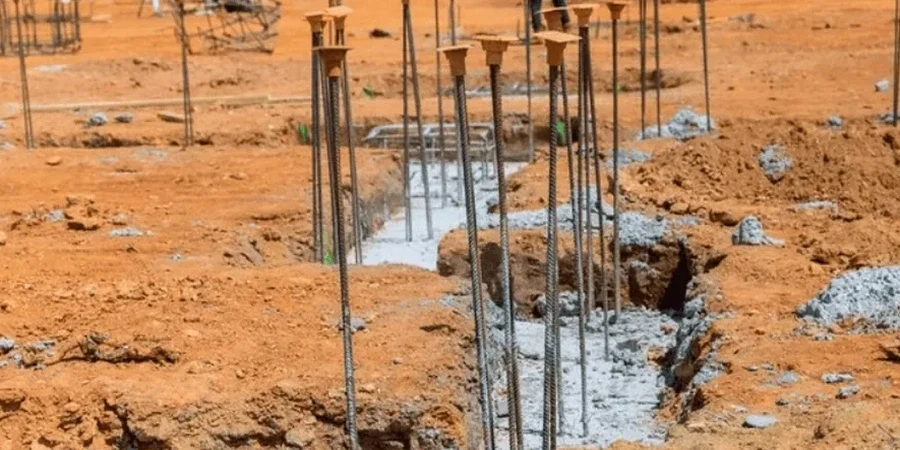
Local ground factors
Scottsdale’s post-war expansion from a small agricultural town into a luxury resort destination meant that prime desert land was developed rapidly, often with limited subsurface documentation. Older commercial buildings along Scottsdale Road may sit on spread footings that predate modern expansive soil awareness, making adjacent new construction risky. When we design pile foundations near these legacy structures, vibration monitoring becomes mandatory if driven piles are selected, though in practice we favor drilled shafts to avoid settlement claims. Another challenge is the potential for differential heave between a deeply anchored pile and grade-supported flatwork; we address this by specifying void forms or collapsible layers beneath slabs. The use of in-situ permeability testing helps verify that post-construction irrigation from landscaping will not saturate the bearing clay and trigger long-term heave cycles that could overload the piles in tension.
Reference standards
IBC 2021 (International Building Code), Chapter 18, ASCE 7-22 Minimum Design Loads for Buildings, ASTM D1586 Standard Test Method for SPT, ASTM D2487 Classification of Soils (USCS), ASTM D1143 Deep Foundation Load Test
Complementary services
Geotechnical Exploration & Lab Testing
Rotary wash borings, CPT soundings, and laboratory swell-consolidation tests to characterize the soil profile and caliche variability across the site.
Pile Capacity & Group Analysis
Static capacity calculations using α, β, and O'Neill & Reese methods, plus finite element group settlement analysis under combined axial and lateral loading.
Load Test Program Design
Preparation of ASTM D1143-compliant test procedures, reaction frame design, and interpretation of load-movement curves to validate the production pile design.
Typical parameters
Common questions
What is the cost range for a pile foundation design package in Scottsdale?
A complete design package—including geotechnical exploration, laboratory testing, and structural design of the pile foundation—typically ranges from US$1,620 to US$6,380, depending on the number of borings, the depth to competent bearing strata, and whether a full-scale load test is required. Custom homes on challenging hillside lots tend toward the upper end.
Why are shallow foundations so problematic in Scottsdale?
Much of Scottsdale is underlain by expansive clay derived from weathered volcanic and granitic parent rock. This clay can swell 30% or more when wetted, exerting uplift pressures that crack slabs and grade beams. Caliche layers can create a perched water condition after irrigation, exacerbating the swelling cycle. Deep piles bypass this active zone entirely.
How do you verify that a pile will perform as designed during construction?
We specify either a static load test per ASTM D1143 or high-strain dynamic testing during driving. For drilled shafts, we require downhole inspection to confirm the socket length and cleanliness before concrete placement. The acceptance criteria are tied directly to the design loads and the allowable settlement defined in the project's structural specifications.