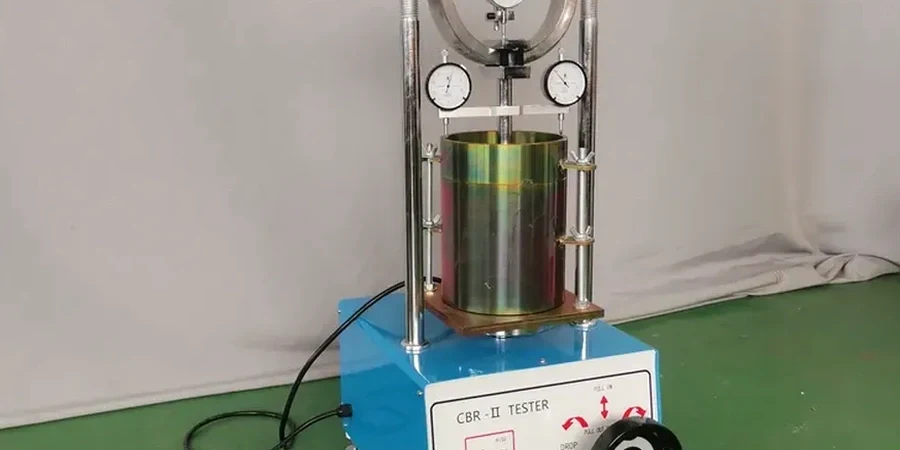
The CBR press in our lab applies a calibrated penetration load through a standard 1.95-inch piston at 0.05 inches per minute, measuring the bearing resistance of compacted specimens prepared from Scottsdale project sites. These specimens are soaked for 96 hours to simulate the worst-case moisture scenario that desert subgrades rarely see until a monsoon storm hits, which is exactly why the test matters here. When a contractor near the Loop 101 corridor needs to validate a pavement section for a new commercial development, we run the soaked CBR on material taken directly from the graded subgrade. The data feeds straight into the AASHTO 1993 pavement design equation, determining the structural number and ultimately the asphalt or concrete thickness required. For projects in the McDowell Mountain area where decomposed granite transitions to clayey sands, we often see the soaked CBR value drop by 40% or more compared to the unsoaked condition, a shift that must be captured before construction starts. This test, when paired with field density verification using a sand cone density test, closes the loop between laboratory expectation and field performance.
A soaked CBR of 3 on a Scottsdale clay subgrade can demand double the base thickness compared to a CBR of 8 on granular material less than half a mile away.
How we work
Local ground factors
Scottsdale sits at approximately 1,250 feet above sea level, and its stormwater infrastructure must handle sudden runoff from the McDowell Mountains during the July-August monsoon, when a single afternoon can deliver over 2 inches of rain in under three hours. Pavement sections designed with an unsoaked CBR, or with a soaked value that was not truly representative of the imported fill, begin to show distress within the first two monsoon seasons: alligator cracking in the wheel paths, edge failure along curb lines, and in severe cases, base pumping through the asphalt. The financial consequence of a CBR value that is off by 4 points on a 50,000-square-foot parking lot can exceed $80,000 in premature rehabilitation, a number we have seen validated on projects along the Shea Boulevard commercial corridor. Because Scottsdale enforces the IBC with local amendments and requires geotechnical reports for all public right-of-way improvements, subgrade verification is not optional. For flexible pavement design, the soaked CBR drives the entire structural section, and when the value is below 6, the design shifts from conventional asphalt over aggregate base to a lime-stabilized subgrade or a rigid pavement alternative.
Process video
Reference standards
ASTM D1883-21: Standard Test Method for California Bearing Ratio (CBR) of Laboratory-Compacted Soils, ASTM D1557-12(2021): Standard Test Methods for Laboratory Compaction Characteristics of Soil Using Modified Effort, AASHTO T 193: The California Bearing Ratio, IBC 2021 Chapter 18: Soils and Foundations (adopted by City of Scottsdale with amendments)
Complementary services
Standard and Modified Proctor Compaction
Establishes the moisture-density relationship for the soil being tested, per ASTM D698 or D1557. The CBR specimens are compacted at optimum moisture content unless the project specification requires a different target.
Swell Potential Measurement During Soaking
The CBR mold is instrumented with a dial gauge to record vertical swell during the 96-hour soaking period. On Scottsdale clays we have measured swell exceeding 0.25 inches, which flags the material as expansive and triggers additional recommendations.
Pavement Thickness Design Support
We take the soaked CBR value and assist the project civil engineer with the AASHTO 1993 design equation, providing the structural number and layer coefficients needed to finalize the pavement cross-section for City of Scottsdale submittal.
Typical parameters
Common questions
How much does a laboratory CBR test cost for a Scottsdale project?
For a single-point CBR test on one soil type, including the Proctor compaction curve and the 96-hour soaking period, the cost ranges from US$120 to US$210. The final price depends on whether we are testing one compaction effort or the full three-point family of curves, and on the number of specimens required by the project specification.
Why is the soaked CBR value so much lower than the unsoaked value on desert soils?
Arid-region soils like those in Scottsdale often have a weak cementation from calcium carbonate or silica that holds the particles together in a dry state. When the specimen is submerged for 96 hours, that cementation dissolves or softens, and the soil structure collapses under the surcharge load. The drop can be dramatic, from an unsoaked CBR of 25 or 30 down to a soaked CBR of 4 or 5 on clayey sand with caliche fragments.
How many CBR tests does the City of Scottsdale require for a commercial development?
The City of Scottsdale generally follows the geotechnical engineer's recommendation, which is based on the variability of the subgrade. On a typical 5-acre commercial lot, we recommend a minimum of three CBR tests if the soil is uniform, and one test per each distinct soil type encountered if the borings reveal significant variation. The report must be stamped by a registered Arizona professional engineer.
What penetration correction is applied if the CBR curve does not start at zero?
Per ASTM D1883, if the initial portion of the stress-penetration curve is concave upward, we apply a zero correction by extending the straight-line portion of the curve down to the penetration axis and shifting the origin to that intercept. The corrected stress values at 0.1 and 0.2 inches are then divided by the standard stresses, 1,000 psi and 1,500 psi respectively, to compute the CBR. The higher of the two values is generally reported, unless the 0.2-inch value exceeds the 0.1-inch value, in which case the test is repeated.