The soil profile beneath a job site near Old Town Scottsdale rarely resembles what you find out toward Troon North. In the downtown corridor, decades of irrigation and buried alluvial channels create pockets of soft, collapsible material, while the northern foothills present dense, cemented caliche that can shatter a bucket tooth. That contrast defines the challenge of stone column design in the Valley. A single subdivision might straddle both conditions within four hundred feet. Our process starts with mapping those transitions—because a column array sized for sandy loam will underperform in desert hardpan, and vice versa. We combine site-specific drilling data with the SPT drilling refusal patterns we have logged across northeast Scottsdale to model the treatment depth and column spacing that actually hold. The goal is not just bearing capacity on paper: it is differential settlement under summer monsoons, which is when most Scottsdale soils show their true behavior.
Scottsdale’s collapsible basin soils can lose over 10 percent of their volume under saturation—stone columns prevent that settlement before the slab is poured.
How we work
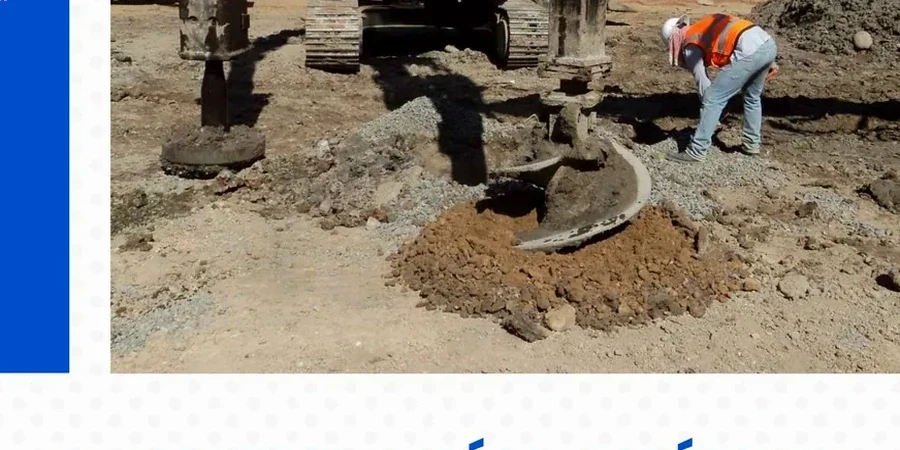
Local ground factors
Scottsdale’s build-out accelerated after the CAP canal reached the city in 1985, pushing residential development onto basin-fill soils that had been cattle pasture for a century. That land-use history left behind old irrigation berms, undocumented well backfill, and stratified silts that do not appear on USGS quad sheets. When stone column design skips the pre-production test array, the first indication of trouble is usually a tilted floor slab eighteen months after CO. We have reviewed enough forensic files from the McCormick Ranch area to know that column diameter and spacing cannot be copied from a Phoenix spec—Scottsdale’s slightly higher elevation means a thinner Holocene cap over Pleistocene clays, changing the drainage basement depth. Our risk protocol includes a minimum of three probe columns with CPT verification before production starts, plus a settlement monitoring benchmark tied to the city’s existing survey control network. The monsoon season—July through September—complicates scheduling because saturated fines slow the vibratory penetration rate by nearly half, so we stage the work to finish the probe phase before the humidity spike.
Reference standards
ASTM D1586 Standard Test Method for Standard Penetration Test (SPT), ASTM D2487 Standard Practice for Classification of Soils for Engineering Purposes, 2021 IBC Chapter 18 – Soils and Foundations
Complementary services
Stone Column Design Package
We prepare the column layout, aggregate specification, and settlement analysis required for Maricopa County plan review. Each submittal includes a collapsibility assessment tied to SPT data, a Priebe-method bearing capacity calculation, and a construction sequence that accounts for adjacent structures and existing utilities.
Field Installation Support & QA
Once the design is approved, our team manages the pre-production test array, logs probe refusal depths against the geotechnical baseline, and runs post-installation CPT verification. We adjust column spacing in real time based on the vibro probe amperage and the aggregate take per foot.
Typical parameters
Common questions
What is the typical cost range for stone column design and QA in Scottsdale?
For a single-family residential lot or small commercial pad in Scottsdale, the combined design package and field QA typically falls between US$1,250 and US$5,510 depending on the number of columns, depth of treatment, and whether a pre-production test array is required by the city. Larger multi-acre sites are quoted based on the column count and verification testing scope.
Why are stone columns preferred over over-excavation in Scottsdale basin soils?
Over-excavation in Scottsdale's collapsible basin deposits often requires removing 15 to 25 feet of material, which triggers dewatering, shoring, and huge import fill volumes. Stone columns treat the problem in situ without exporting soil, and the lateral densification effect improves the ground between columns, something over-excavation and recompaction cannot achieve without extending the cut well beyond the building footprint.
How do you verify that the stone columns are performing correctly after installation?
We run a CPT sounding through the center of a test column and compare the tip resistance and sleeve friction to the pre-treatment baseline. A properly installed column in Scottsdale's alluvium should show a tip resistance increase of at least 80 percent in the surrounding soil within two column diameters. We also perform a modulus load test on a rigid plate bearing on a group of columns to confirm the design settlement target under the IBC allowable load combination.